When pond owners think about creating a productive and exciting sport fishery, largemouth bass and bluegill are often the first species that come to mind. However, for larger ponds and lakes with the right management strategy, black crappie (Pomoxis nigromaculatus) can provide another highly desirable fishing opportunity.
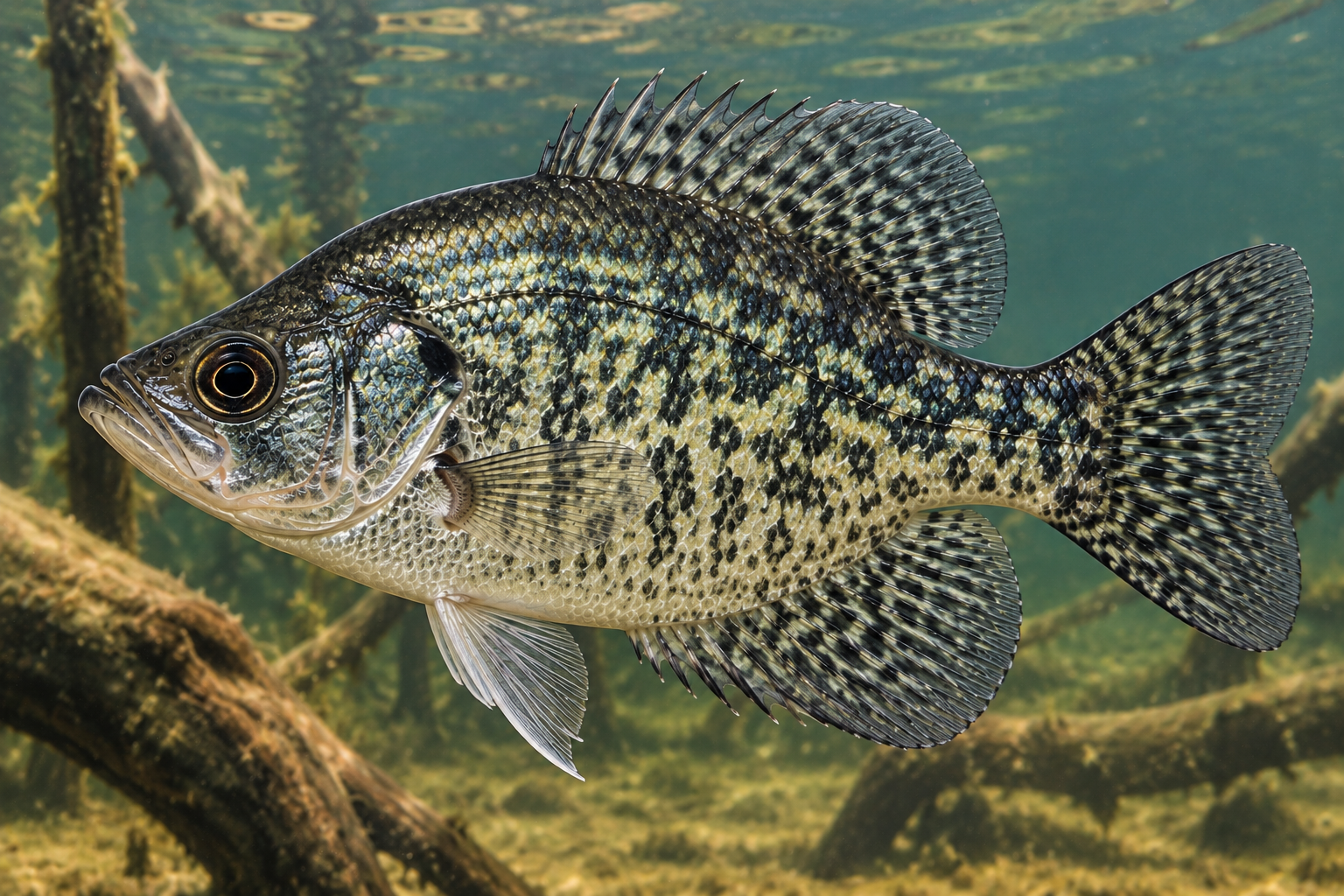
Black crappie are native freshwater sport fish recognized by their deep, laterally compressed bodies and irregular pattern of dark black or greenish blotches scattered across their silvery sides. Unlike white crappie, which typically display distinct vertical bars, black crappie have a more mottled appearance. They also typically have 7 to 8 dorsal fin spines, compared with 5 to 6 in white crappie.
Why Stock Black Crappie?
For many pond owners, the biggest reason is simple: black crappie are excellent sport fish.
Crappie are known for schooling behavior, aggressive feeding, and excellent table quality. Once a school is located, anglers can often catch several fish from the same area, making them especially enjoyable for recreational fishing.
Adding black crappie can also increase the diversity of fishing opportunities within a properly managed pond. Instead of managing exclusively for largemouth bass and bluegill, some pond owners may want a fishery that provides several desirable species throughout the year.
Black crappie are also an important predator. As juveniles, they consume zooplankton, aquatic insects, and other small organisms. As they grow, fish become an increasingly important part of their diet. A strong forage population is therefore essential for producing healthy crappie with good growth rates.
Habitat Matters
Black crappie generally prefer clearer water than white crappie, although they can thrive under a range of conditions. They are strongly associated with structure and cover, including submerged trees, brush piles, standing timber, aquatic vegetation, docks, and other underwater habitat.
This behavior creates another advantage for pond owners: crappie can often be concentrated around strategically placed habitat, creating predictable and productive fishing areas.
Quality habitat also benefits the entire fish community. Woody structure can provide cover for juvenile forage fish and surfaces for periphyton and other aquatic organisms to grow. At Edge’s Aquatic, we generally prefer natural hardwood structure first, with properly designed artificial habitat serving as another useful option.
Reproduction Requires Careful Management
Black crappie typically spawn during the spring when water temperatures rise. Males construct nests in shallow water, often near vegetation or other cover, where females deposit their eggs.
Their reproductive ability can help establish a self-sustaining population, but this is also where careful management becomes extremely important.
Crappie are known for producing inconsistent year classes. One spawning season may produce relatively few surviving young, while another can produce an abundance. If too many juvenile crappie survive, they can compete heavily for available food. The result may be an overcrowded population dominated by smaller, slow-growing fish.
They can also compete with young largemouth bass and other predators for forage.
For these reasons, black crappie generally aren’t a fish we recommend simply adding to a pond without first evaluating the existing fishery.
When Can Black Crappie Be Beneficial?
In the right pond, black crappie can be an excellent addition. Larger, established ponds with abundant forage, suitable habitat, and a healthy predator population are generally much better candidates than small or newly established ponds.
Largemouth bass play an especially important role because predation helps control young crappie. Maintaining the proper balance between predators, forage fish, and crappie is critical for producing quality fish rather than an overcrowded population.
Before stocking, we look at factors such as pond size, existing fish populations, forage availability, habitat, water quality, predator abundance, and the owner’s long-term fishing goals.
At Edge’s Aquatic, we don’t believe successful pond management is simply about stocking more fish. It’s about stocking the right fish in the right environment and then managing the entire ecosystem to help those fish reach their potential.
If you’re interested in adding black crappie to your pond or lake, contact Edge’s Aquatic. We can evaluate your fishery and determine whether black crappie fit into your long-term pond management goals.
If you’re ready to take your pond to the next level, contact Edge’s Aquatic today to schedule a pond evaluation. We’ll help you build the habitat your fish need to thrive—and the pond you’ve always wanted.
Our Services Include:
- Sterile Triploid Grass Carp
- Fish Stocking
- Electrofishing Surveys
- Aquatic Vegetation Management
- Pond Aeration and Fountain Installation
- Water Quality Improvement
- Pond Consulting and Management Plans
Fish We Stock:
- Oxbow Largemouth Bass
- Bluegill
- Shellcracker
- Golden Shiners
- Fathead Minnows
- Channel Catfish
- Crappie
- Sterile Triploid Grass Carp
Edge’s Aquatic
Home of the Oxbow📞 For Georgia and Southeastern states:
Edge’s Aquatic
Soperton, GA
Phone: (912) 529-3315
Website: www.pondstockingofgeorgia.com
“We sell quality, not quantity.” “Edge’s Aquatic is Home of the Oxbow Bass.”
Serving portions of Georgia, Alabama, Florida, North Carolina, and South Carolina with professional pond and lake management solutions.
Contact us today for a free consultation and let us help you build a healthier, more productive pond.
Kim, Keith, and The Team
Edge’s Aquatic
Find us on social media: